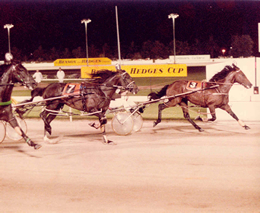
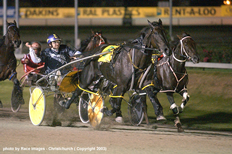
|
A Little Bit of History
Gloucester Park - Home of the Inter Dominion by Alan Parker
©
Trotting began to be organised in Western Australia in 1910
with the formation, on 22nd September, of the Western Australian Trotting
Association.
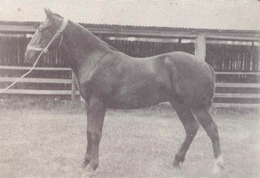
Prior to that date the only organised events were at the annual Perth Show, run by the Royal Agricultural Society. Since 1887 events had been included for roadsters and the first classes for trotters appeared in 1890. These first trotters appeared in a category of "Trotters by Bay Shales". Bay Shales was an English bred Norfolk Trotter imported to Western Australia in 1886 by John Liddelow. At the 1896 Show a trotting contest was held between two former Victorian
trotters in Palo Alto and Oakleigh along with a son of Childe Harold called
Harold and a local horse called Dick. Dick, driven by Mr. Hummerston won
the event from Oakleigh.
The number of trotters exhibited at the annual
Royal Show grew slowly until by 1905 there were more than 40 horses entered
in the various classes. That year saw, for the first time, the name of James
Brennan among the competitors. Brennan's horse was an eight year old named
Castlecomer in honour of his birthplace in Ireland. By 1910 the number and quality of horses had improved to the point where
it was announced, in The West Australian newspaper on 2nd September 1910,
that James Brennan would guarantee prizemoney of 50 pounds for two events
at that year's Show. The same paper announced the attempt to form a trotting
association. The first Committee meeting of the W.A.T.A.
was chaired by Brennan with Albert Mayor, a hair specialist, Honorary
Secretary and Messrs. George Hiscox, A E Cockram, Shirley White and C
McManus as members of the Committee. The other foundation members of the
WATA were A W Wallder, H A Hummerston and A A Frieee. The trotting events at the 1910 Perth Royal Show were run jointly by
the WATA and the Royal Agricultural Society using the rules of the Victorian
Trotting Association until local rules could be put in place. Among
those events at the 1910 Show held at the Claremont Showgrounds, were
a series of time tests for a total of 63 pounds in prizemoney. On 3rd
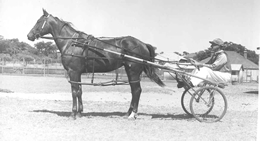
November 1910 Big Ben, a giant gelding of unknown pedigree, trotted
a mile in 2:30 to become the State's first official Standardbred performer. On Christmas Eve 1910 the WATA held its first race meeting at the Belmont
Park racecourse. Seven events were held on a hot, humid Saturday afternoon
with the first race being won by M & T Humphries' mare Princess
Huon. Princess Huon was one of four horses which each had four starts
that afternoon, covering a total of nearly five miles. The WATA continued to conduct racemeetings on a fortnightly basis,
using both Belmont Park and the Claremont Showgrounds as venues. A 25
pounds per meeting rent for the Showgrounds was placing a financial
burden on the WATA and, in March 1913, an agreement was negotiated for
a five year lease of a trotting track on the perimeter of the Western
Australian Cricket Association Ground. Provision for night trotting
was made in the agreement. Because of the scope of this financial agreement,
on 11th April 1913 Messrs James Brennan, James Nicholls and Henry A
Hummerston became financial guarantors of the WATA for the five year
period of the original lease. The guarantors were given the power to appoint sufficient nominees
to the Association's Committee as required to retain voting control.
While it was only intended that the guarantor system would be required
for a period of five years, it was to remain in place until 1946. Three months after signing the lease agreement the WATA began racing
on the WACA Ground track, on 28th June 1913 in front of a crowd of 1200
people who put 300 pounds through the on-course totalisator. The Association's
timekeepers D C Braham and W McNamara had the idea of trotting under lights
to avoid clashes with gallop' meetings.
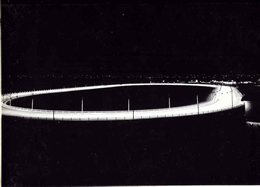
On 2nd January 1914 a quote of 379 pounds, from Leo Walton's Electrical
Wiring Company, was accepted for the installation of lights at the WACA
track. Australia's first complete meeting under lights was held at the
WACA on 24th January 1914 with the running of five races. The first
event was won by Alfred Fox driving Battler 11. A battle for control of trotting dates had been fought from 1912 until
the Premier of Western Australia assumed direct control over the allocation
of racing dates with the advent of World War 1. On 1st March 1917 the Racing Restriction Act was introduced in the
State's Legislative Assembly. When it was passed later that year, the
Bill provided for all trotting meetings to be held under a licence issued
by the WATA. On 23rd April 1914 James Brennan reported to the WATA Committee that
the WA Cricket Association was prepared to sell 17 acres of land on
the northern side of their ground. Months of negotiations followed between
the WATA, WACA, Perth City Council and Land's Department and on 2nd
July 1915 an agreement was signed to purchase 14 and a half acres of
land for the sum of 6000 pounds on a deposit of 100 pounds. It took
the WATA a further six years before they were able to purchase the last
of the blocks in Waterloo Crescent to give them sufficient land to build
the course. The bulk of the land was a mosquito ridden swamp and between 1917 and
1920 the site was used as the Perth City Council's rubbish tip, with
the WATA paying the wages of the tip foreman. Architects Powell and
Cameron were appointed on 6th May 1920 while A T Brine & Sons began
work on the drainage of the site. Lighting specifications were obtained
from American, British, French, German and Swedish firms for a system
which saw 750 miles of electrical wiring and 180 tonnes of equipment
suspended over the track. The original installation was carried out
by the local firm Brear & Doonan, who are still the Association's
Electricians.
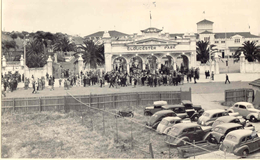
Stockpiling of 30,000 yards of shell, dredged from the Swan River,
began in 1925 but, by the end of 1927, a series of inaccurate cost and
quantities estimates were beginning to affect progress on the construction
of the track. At that time some 50,000 pounds had been spent on the
course, and it was estimated that a similar amount would be required
to complete the construction of essential facilities, such as totalisators,
grandstand, offices and fences. Twelve months later the bill had risen
to 100,000 pounds and the track had still not been completed and the
WATA had only six months of their lease of the WACA track remaining. Money was looming as a major problem, as falling world prices for agricultural
products, and a loss of overseas capital in Australia, was beginning
to take effect. Brennan and his fellow Committeemen sought the assistance
of Perth businessman John P Stratton. Stratton was able to obtain the necessary loan and, on 5th February 1929, he became one of the three guarantors which the Bank of New South Wales required. He replaced WA Smiley as Vice-President of the WATA and shortly thereafter the official architects were replaced. A grandiose grandstand, modelled on the Addington stand in Christchurch,
was replaced with a less elaborate model, similar to that at the Kings
Park Tennis Club, as Stratton continued his push to have the track completed.
The first race meeting at the track was held on 26th December 1929
and a crowd of some 17,000 people saw Alween, with F Mackander at the
reins, win the opening event at the track named Brennan Park, in honour
of the man to whom Western Australian trotting owed its existence. Completed at a cost of 200,000 pounds at the time of The Great Depression,
the track was variously described as the best in the Southern Hemisphere
and the equal of any in the World. Its first class facilities included
the latest Julius "Premier" totalisator capable of handling
3000 pounds per minute in pound units. It provided 86 windows for punters
and was able to automatically display win and place odds for each horse.
The course was officially opened by Perth's Lord Mayor J T Franklin
on 15th March 1930 and the feature events at that night's meeting were
named after Brennan and Stratton. Later that year James Brennan resigned
as a member of the WATA Committee and J P Stratton became President
of the Association. It was a position which he would hold for 36 years
until his death. In September 1923, at a Conference of trotting officials, James Brennan presented the concept of an annual championship to be rotated among the Australian States, New Zealand and the United States of America. He received a lukewarm response from the other delegates, however Brennan was able to convince his fellow Committeemen to go it alone. In 1925 and 1926 the WATA conducted the Australasian Trotting Championship
at its WACA Ground track. New Zealand was represented by Great Hope
and Taraire in 1925 and both horses came to Perth with earnings in excess
of 5,000 pounds. Great Hope won the championship from the Victorian
stallion Vin Direct. Taraire was left in Perth and won the 1926 Championship
from the New Zealand champion Great Bingen. Great Bingen was part-owned
by Roydon Lodge Stud founder John McKenzie. Brennan's idea was ahead of its time however and the concept was all
but forgotten until fellow Western Australian J P Stratton resurrected
the idea at a meeting of trotting administrators in Sydney in 1935.
The first Inter Dominion Championship was allocated to Perth and
was held at Gloucester Park on 8th, 12th, 15th and 19th February 1936.
While the administrators of the time deserve plaudits for the Inter Dominion
concept, they deserve censure for the points system they devised to determine
the Grand Champion.
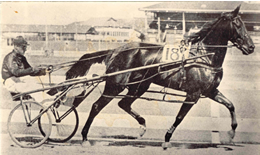
Realising the inadequacies of asking top horses to concede handicaps
to other top horses in champion-class races, they had devised a scheme
whereby the placegetters in each heat and the final received 3, 2 or
1 point. In addition the three fastest horses in each heat received
3, 2 and 1 point. Logan Derby went through the Championship undefeated
and earned a total of 18 points. The mare Evicus finished second in
each of her four starts and earned 20 points to be declared Grand Champion. In its first season of operation at Gloucester Park, the WATA held
52 meetings and paid 33,365 pounds in stakes. By 1940 the figures had
increased to 53 meetings for 122,289 pounds as the Association continued
its steady progress despite the interruption of World War II. In 2003
meetings at Gloucester Park distributed nearly $8 million in stakes. During the war years racing was held on Saturday afternoons and at
times only held fortnightly, due to a sharing agreement over dates with
the WA Turf Club which raced alternate Saturdays. Technological change in society has also been reflected in the many
changes made at Gloucester Park over the years. Photo finish facilities were introduced to Gloucester Park in August
1949, and used for the first time to decide the outcome of a race on
20th August 1949. Fair Lily was declared the winner from Sheikson, Redfred
and Mardon Girl. The first deadheat declared after the introduction
of a photo finish came about on 2nd September 1950, when the photo showed
that Attaboy (Charlie Allen) and Step Lad (Fred Hough) could not be
separated. On 15th November 1930 Gloucester Park witnessed its first triple deadheat when the judge was unable to separate Ella Derby (Harry Moran), Red Derby (Stan Woodworth) and Nelson McCormack (Jim Morgan). It is purely conjecture whether he would have come up with the same result had he had photo finish facilities. Currently Gloucester Park races feature a mix of standing and mobile
starts. The rubber strand method of starting horses from a stand was
brought to Western Australia in 1935 by a seventy year old Victorian
called H Brenning. Previously races had been started by pistol shot.
Legend has it that the champion pacer of that era, Adonaldson, used
to watch the starter's pistol and start on the appearance of smoke from
the muzzle. This gave him a split-second advantage on those who waited
for the sound of the pistol shot to carry. Adonaldson lost that advantage
when the starter stood on his mechanical release after 1935. A mobile barrier was used at Gloucester Park for the first time
on 24th May 1958. The winner of the race was the notoriously unruly Edward
Scott. The machine was consigned to the scrap-heap after a short period
of use and was not re-introduced until January 1972 when Roscott won that
year's Mount Eden Mile.
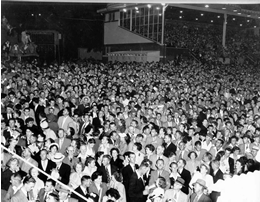
Television came to Perth in the late 1950’s and on November 4, 1960
the 5000 pound Anniversary Cup was replayed to Perth television audiences
on the ABC's Sports Cavalcade programme. The champion Sydney pacer Apmat,
with legendary driver Bert Alley at the reins, won the race from Defiance
and Kiwi Dillon. A decade later, on February 28, 1970, the WATA held a seven race programme
at Gloucester Park but only six were run at the track. The seventh race
was a live telecast of the Inter Dominion Final from Melbourne featuring
the local idol Dainty's Daughter. Television came to the assistance of stewards on October 1, 1971 with
the introduction of race patrol films. A little over a year later, on
October 21, 1972, metric race distances were introduced to Gloucester
Park. The WATA resisted the dropping of mile rates and for a period
both mile rates and kilometre rates were used. When the Metric Conversion
Board went into mothballs, so too did kilometre rates. On May 3, 1985 the Gloucester Park track changed dramatically when
the old circuit was torn up and a new half-mile oval was put in its
place. Not that the old track was slow. In fact on March 11, 1983 it
had become the nation's first 1:55 track with the 1:54.9 time trial
of the four-year-old stallion Classic Garry. Classic Garry is just one of a host of outstanding champions who have
raced at Gloucester Park and the list is not restricted to those who
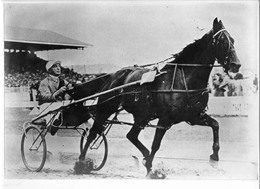
competed in Inter Dominions. When trotting began in Perth in 1910 it didn't take long for the first of a long line of champions and crowd favourites to emerge. Hector Mac was the first public idol. So much so that when he died in 1929 his bones were laid to rest under the winning post of the Gloucester Park track. In 1997 the ashes of the 1967 Inter Dominion champion Binshaw were also laid to rest under the Gloucester Park winning post. Hector Mac raced at the WACA, as did other champions including Kola
Girl, Princess Wilkes, Cole Queen, Earl Derby, Great Bingen and Craboon.
The first of the public idols at Gloucester Park was the black stallion
Adonaldson who won the 1934 Gloucester Cup. By the sensational sire
Alfred Donald, he was one of a number of outstanding racehorses produced
by his dam who went by the simple title of Jill. In 1937 Kolect wrote his name into the record books when he won the
WA Cup from a backmark of 108 yards. Kolect's dam Kola Girl had won
the Cup in 1918 and she remains the only Cup winner to have produced
a WA Cup winner at stud. Kolect's son Kolrock won the 1940 WA Cup from the champion mare Queen's
Gift who reversed the result in 1941. Both horses were champions and
crowd favourites at a time when war clouds preoccupied the minds of
those who watched racing at the track. Dark David, a black son of Storm Cloud, won the WA Cup in 1947. That
year the stallion Don Sebastian was mated with a mare called Nellie's
Vin. The resultant foal was the sensational Beau Don which won the WA
Cup in 1952 and 1953 and established a trend for crowd popularity that
was later matched by only the likes of Mount Eden, Pure Steel and Village
Kid.
Such was the adulation afforded Beau Don that when he fell in a heat
of the 1952 Inter Dominion, the crowd were close to rioting, based on
the level of vitriol hurled at New South Wales reinsmen Perc Hall and
Harry Mazoudier. The crowd thought that they had been at fault in causing
the fall.
Although Frosty Nelson won 35 races at Gloucester Park in the 1950's
he never got under the skin of the fans in the way that Beau Don did.
In the 1960's crowds thrilled to the clashes between Radiant Oro, Dainty's
Daughter, Binshaw, Blue Pennant and Renaud. Never in 85 years of trotting
in this State has there been a depth of fast class talent to match that
of the years 1967 - 1970. The track's first 2:00 mile was recorded in
this period. To that talent was added the sensational speed machine Mount Eden.
A horse that was years ahead of his time, Mount Eden remains the fastest
horse seen in Australia. The times that he recorded in 1971 gave him
the status of the best pacer in the World and crowds flocked to see
him. Prior to his leaving Perth for the 1971 Miracle Mile, 5000 attended
his trials at Gloucester Park. There will never be another to grab the
imagination of people quite like Mount Eden. In 1975 the WA Derby was won by a nuggetty colt whose name was probably
the most fitting ever given to a champion horse. Pure Steel was exactly that and he forged a reputation as the toughest
stayer seen in Australia. His four successive WA Pacing Cups is legendary,
although he was never able to win an Inter Dominion Championship. He
was twice placed in the Final and ranks as the greatest horse never
to win the event. The Gloucester Park track has witnessed a host of champion horses in
the 1980's and 1990's, including the likes of Satinover, San Simeon,
Popular Alm, Gammalite, Preux Chevalier, Franco Tiger, Our Maestro,
Luxury Liner, Black Irish, Wondais Mate, Koala King, Jack Morris, Our
Sir Vancelot, Westburn Grant and Sunshine Band to name but a few.
One horse has stood out however. Village Kid won four WA Cups to go
with nine other Group One wins on his way to Australian Record earnings
of $2,117,870. He ranked as the World's Richest Pacing Gelding and,
at the age of 13, he set a world Record for a horse of his age when
he time trialed in 1:55.1. Village Kid attracted fans to the track like
no other horse since the great Mount Eden. The longevity of his race
track career contributed to this, as did his period of dominance of
Australian harness racing. As Gloucester Park approaches the 70th Anniversary of the running of
the first Inter Dominion, it is time to reflect on how strongly the
course has become part of the Perth landscape and the culture of the
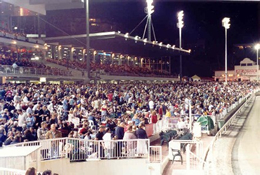
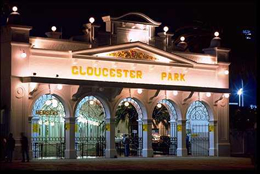
city. With its magnificent entrance, the course remains unique in Australia
as a leader for others to follow.
|
| Down Memory Lane
- Perth Inter Dominions
by Alan Parker
©
The 2004 Inter Dominion will be the eleventh Championship
held in Perth since the inaugural series in 1936. The Finals read like
a Who's Who of Australian trotting history and, to help people remember
those Perth Inter Dominions from days gone by, we publish here the full
result for the Finals and Consolations held in Perth.
1936 - The Ball Starts Rolling The 1936 Inter Dominion gave Perth trotting fans the opportunity to
see one of the Southern Hemisphere's truly great champions compete.
Logan Derby, a diminutive brown stallion by the breed-founder Globe
Derby from Belle Logan, made a clean sweep of the inaugural Inter Dominion,
defeating Evicus and the Frank Kersley driven Nancywood in the final. Three heats wins and an equally effortless win in the grand final should
have been enough but an iniquitous points-scoring system saw the gold
champion's cup presented to the connections of the mare Evicus.
Evicus failed to win a single event during the championship but the
fastest time points she earned from her 36 yards back-mark gave her the
title. That first championship saw eight interstate horses in Perth to
battle with twelve locals. The concept of a true Inter Dominion contest
was well and truly born. Unlike the 2000’s when the visitors fly into Perth, in 1936 they came
either by boat or by train. The latter method of transport provided a
bonus for trotting fans in Kalgoorlie On February 22, 1936, a week after the grand final was held, five of
the visiting horses took part in races in Kalgoorlie. It had been necessary
for the horses to change trains in Kalgoorlie, due to the different gauges
of the railway, and their trainers took the chance to race with both hands
as the following report from The Western Australian show; "Six horses were listed to appear, but Auburn Lad, who has been
suffering from a bad leg, was unable to race. In the first event for the
visiting horses Speedy Boy and Wirra Walla faced the barrier, but with
Wirra Walla a sick horse there was little doubt about the verdict… In
the second event which was contested by Logan Derby, New Derby and Mintor
Ribbons, Logan Derby continued in winning vein…"
Although Evicus and Emilius Way were on the train they did not start
in Kalgoorlie. This pair did however compete in a race at Wayville on
Februrary 29, 1936 with the five horses that started at Kalgoorlie. Who
says that the modern day standardbred has it tough 1936 INTER DOMINION FINAL
STAKE: $3,000 DISTANCE: 12 furlongs (Standing Start)
Margins:6 yards, 3 yards
Trainer of winner: J Agnew
Owner of winner: W H Barnes 1940 - A WA winner despite what records say Then a nine year old, Logan Derby returned to Gloucester Park in 1940
for the second Inter Dominion. His 1936 nemesis Evicus also returned
to Western Australia. The points system, which had robbed Logan Derby
in 1936, now saw the stallion awarded the Grand Champion prize. Unlike Evicius, who had finished second in the Final, Logan Derby failed
to finish in the first three in the ultimate race of the Championship.
Grand Mogul, a nine year old gelding by Adioo Guy (sire of the dam
of the legendary Adios before his importation from the USA to New Zealand),
narrowly won the Final from New South Wales representative Master Dixie
and the local Moreica.
Trained and driven by Keith Anderson, Grand Mogul was officially
shown as being owned by New Zealander G J Barton. The cheque went to Western
Australian W J Sykes, who had purchased the horse but was forced to wait
until the transfer was verified by the WATA Committee, after the Inter
Dominion had been conducted. Fred Kersley senior won the first Consolation with Binnia in 1940.
He had driven Lulu Mick in the heats of the 1936 Inter Dominion and was
the last surviving driver from that first series until his death in 2001. Jack Watts wrote his name into the record books when he drove a winning treble at Gloucester Park when he was successful with Huon's Rock, Gay Polly and Flying Globe. Former New Zealander Michael Langdon is the only other visitor to drive
a winning treble at Gloucester Park. Langdon achieved it with Beefy T, The
Suleiman and Advance Tempo on November 10, 1995. After the 1940 Inter Dominion Logan Derby stayed in Western Australia
at J P Stratton's stud. After producing just a handful of foals in this
State, Stratton sent Logan Derby to New Zealand where the stallion sired
the legendary Johnny Globe. 1940 INTER DOMINION FINAL
STAKE: $6,000 DISTANCE: 13 furlongs (Standing Start)
Margins: 1 yard, half yard
Trainer of winner: K A Anderson
Owner of winner: G J Barton
1947 - The Inter Dominion's most famous grandmother The second World War interrupted the Inter Dominion and there was a
break after the running of the 1940 series. Tasmanian-bred Bandbox was
brought to Perth via Adelaide by her trainer/driver Len Moriarty At Wayville she won three races, including the 1947 South Australian
Trotting Club Cup from a massive 72 yard handicap.
After winning her heat on the opening night, Bandbox finished second to
Western Australian champion Stormy Weather on both the second and third
nights. Trained by his owner Cliffe Clarke and driven by Alex Maclean, Stormy
Weather was unbeaten in the heats and, as the lone scratch-marker, the
gelded son of Peter Stretta was sent out a 6/4 favourite for the Final. The ubiquitous points system saw Bandbox the leading qualifier for
the final, one point clear of Stormy Weather.
She proved to be superior in the final when she finished six yards
clear of Dixie Stretta and Para Derby rating a smart 2:10.8 for the 13
furlongs. Stormy Weather led early on but a tyre blew, his wheel collapsed
and he faded back through the field. Bandbox failed to produce anything of note at stud but her 1965 daughter
by Hundred Proof achieved broodmare immortality as the dam of the greatest
pacer never to win an Inter Dominion. Pure Band produced Pure Steel in 1971 and the Toledo Hanover stallion
was runner-up to Carclew in the 1976 Adelaide final and third in Sydney
in 1980 on his way to more than $900,000 in stakes. It is almost incomprehensible
that a horse could so dominate his opposition for so long and yet fail
to win the nation's premier event. 1947 INTER DOMINION FINAL
STAKE: $16,000 DISTANCE: 13 Furlongs (Standing
Start)
Margins: 6 yards, 6 yards
Trainer of winner: L Moriarty
Owner of winner: F C Eley 1953 - The first horse flight to Perth Avian Derby was the first horse to set foot on the tarmac at Guildford
Aerodrome when a Bristol freighter arrived in Perth at 5.30pm on January
29, 1953. Also on the plane were his stablemates Avondale and Star Music
and the champion New Zealand mare Blue Mist. Unlike the present-day freighter, which uses a hoist to lift the horse
pallets into the body of the plane, the 1953 air travellers used a ramp
to enter the aircraft through the nose. Avian Derby had won the Inter
Dominion in 1952.
Also in Perth in 1953 was the 1950 winner Captain Sandy who was now
a ten-year-old. His trainer Dinny Nolan had brought Captain Sandy on an
1800 mile road-trip in a single float from Adelaide. Nolan had earlier
floated the gelding from Sydney to Adelaide via Melbourne. The Adelaide-Perth
section took a full week in searing summer temperatures Western Australian fans were eagerly awaiting the clash between the
local four-year-old champion Beau Don and the star Sydney four-year-old
Ribands. Beau Don had started just 18 times for 13 wins and three seconds.
His lack of experience was notable when compared to the 37 races won by
Ribands to that point.
Beau Don was a brilliant winner on the opening night, as was Ribands,
however Ribands won on the second night as Beau Don fell in a tangle of
gear shortly after passing the post in a pocket on the back of Riband's
driver Perc Hall. A near-riot followed as local fans gave vent to their
fury which they misguidedly directed at Hall and fellow New South Welshman
Harry Mazoudier.
Captain Sandy had been driven by legendary New Zealand horseman Freeman
Holmes in the heats, however Holmes elected to drive Blue Mist in the
Final. A hesitant Bob Pollock approached Dinny Nolan and was given a trial
drive behind Captain Sandy.
It is history now that Pollock drove the 33/1 chance to a narrow
victory over Ribands and Kellett in front of a crowd listed at 57,000.
Ribands had been sent out favourite at 6/4 and it took a 2:05.8 track
record for 13 furlongs for Captain Sandy to beat him - Captain Sandy took
his earnings to 35,000 pounds and the honour of Australia's richest standardbred.
1953 INTER DOMINION FINAL
STAKE: $20,000 DISTANCE: 13 Furlongs (Standing Start)
Margins: 1.5 yards, 1 yard, 3 yards
Trainer of winner: D J Nolan
Owner of winner: D J Nolan 1957 - Gear changes lead to win Giant South Australian gelding Radiant Venture came to Perth in 1957
with 29 wins in 39 starts to his record. The gelded son of Radiant Robert
had won 23 of his previous 25 starts, including 18 in succession. After a pre-series workout defeat, trainer Max Stephens and driver Frank
Connor changed Radiant Venture's gear so that he could stretch out fully
on the Gloucester Park track. It was significantly bigger than the small
South Australian tracks he had been racing on. An easy win over local champions Beau Don and Magic Flute on the
opening night was followed by a narrow loss to the outstanding New Zealand
champion Caduceus on the second night. At the time Caduceus was being
trained by the doyen of Australian reinsmen in Frank Kersley.
After defeat by Caduceus, further changes were made to the gear of
Radiant Venture and he won a second heat on the third night of the carnival,
defeating Robert Sheen and Mineral Spring.
Radiant Venture started favourite at 7/4 in the Final and coasted home
eight yards clear of the Western Australian duo of Robert Sheen and Precipitation.
Caduceus, who started second favourite, left Perth by road the morning
after the final and linked up with a train in Kalgoorlie for the trip
to Adelaide.
WATA officials caused a stir in 1957 when, in their fight against illegal
SP bookmakers, they put in place an Australia-wide ban on broadcasts of
the Inter Dominion heats. The only race broadcast live on the ABC each
night was the final event on the programme, which incidentally was a heat
of the Inter Dominion. It went to air well after midnight in the Eastern
States. They did allow the ABC to broadcast the Inter Dominion Final live
as the fifth race of the programme that night, however the race was not
scheduled to be run until 10.00pm Perth time.
The WATA President J P Stratton had seen what the proliferation of
illegal off-course bookmakers had done to the local galloping industry
in the 1950's and wasn't prepared to let trotting in Perth go down the
same path. His fight against SP betting eventually led to the introduction
of the Totalisator Agency Board in Western Australia.
1957 INTER DOMINION FINAL
STAKE: $20,000 DISTANCE: 13 Furlongs (Standing Start)
Margins: 8 yards, 3 inches, 6 yards
Trainer of winner: M G Stephens
Owner of winner: M G Stephens 1962 - Cardigan Bay hurt While the champion Sydney pacer James Scott went through the 1962 Inter
Dominion undefeated, and started an odds on favourite when he won the
Final from Len's Hope and Super Paddy, the biggest news story in 1962
was the shock scratching of Cardigan Bay from the race. At the time well-known trotting journalist Arthur Thornton was working
for Perth's Daily News and, thanks to a phone call from the late Leo Keys,
he got the trotting scoop of the decade. Arthur's story on the accident
to Cardigan Bay made front-page headlines that afternoon in Perth - after
the paper stopped the presses to wait for Arthur to file his copy. Some years later Arthur agreed to put pen to paper and recall that fateful
morning. "I had just about finished my copy for the day when Leo Keys rang
and told me to grab a photographer and to get out to Cannington in a hurry.
Naturally enough, I asked what all the fuss was about. He said "Cardigan Bay will have to come out of the final as he's
been hurt".
I remember telling Leo to stop telling tall stories but he insisted
that I get a photographer and get out to Ted Greig's stables. I told my
boss about it and they held the front page of the Daily News pending my
getting back to the office with the story. When we got out to Ted Greig's I could hardly believe what I was seeing.
Cardigan Bay was standing there with his near-hind hip knocked down and
a lot of skin missing from the leg. He had been jogging on the Cannington
track when the jog-cart hit a bump, dislodging his driver. Cardigan Bay
took fright and went hurtling down the road, into the stabling area where
the cart got caught and flung Cardigan Bay onto a concrete apron. There was almost total disbelief at the time and genuine concern that the horse may never race again. I got my story and it filled the front page of that night's paper in Perth, as well as being a major story across Australia and New Zealand. While I have been lucky to witness a lot of incredible Inter Dominion's,
including Mount Eden in Christchurch, I have never seen any more dramatic
than Perth in 1962. The accident to Cardigan Bay robbed the Final of the
biggest danger to James Scott and he would not have started an odds-on
favourite with Cardigan Bay in the field. I had mixed emotions at the time. I was elated at being the journalist to break such a major news story, but bitterly disappointed that the incident had robbed us of what looked like being a truly great Final. It was fitting that Cardigan Bay should recover so well that he was able to win the 1963 series in Adelaide. His owner deserved that". 1962 INTER DOMINION FINAL
STAKE: $25,600 DISTANCE: 13 Furlongs (Standing
Start)
Margins: 6 yards, 12 yards, 1 yard
Trainer of winner: P.J. Hall
Owner of winner: R.E. Fitzpatrick
1967 - First WA bred winner The Inter Dominion returned to Perth in 1967 and produced a local quinella when the five year old gelding Binshaw became the first Western Australian bred pacer to win the country's premier harness race. Binshaw started favourite at 7/2 in a wide-open race and crushed his rivals, winning by 16 yards from outsider Coneeda and Victorian mare Goulburn View, which had attempted an all-the-way win.
Binshaw was having just his seventh start for trainer/driver Phil Coulson
and it was his sixth win for the Wembley horseman. Although only the names
of Bill Bradshaw, Les Dillon and Tom Everett appeared in the racebook,
Binshaw was owned by a syndicate of six, with the other trio being Frank
Bonney, Bruce Curran and Frank Melvin. Binshaw was foaled in 1961, the result of a mating between the champion race horse and sire Bintravis and the average country performer Panminton. While she was nothing sensational, Panminton did win three races and her 1961 foal has ensured that her name will remain in the record books forever. Binshaw's last official duty was to lead the field on to the track for the 1989 Inter Dominion Final at Gloucester Park. It was a task which gave Byford trainer Bill Kersley his share of headaches in the weeks leading up to that night. "I was going to take him out and jog him on the Byford track to tone him
up so he really looked the part for the big night", Bill recalled some
years later. "Trouble was, Binshaw thought it was the real thing and just
wanted to race everything in sight. I ended up having to wait until all
the other horses had left before I could work him". Binshaw died in 1997 and his ashes are buried in the garden adjacent to the Gloucester Park winning post. 1967 INTER DOMINION FINAL
STAKE: $30,000 DISTANCE: 13 Furlongs (Standing
Start)
Margins: 16 yards, 3 yards, 6 yards
Trainer of winner: P.C. Coulson
Owner of winner: W. Bradshaw, L. Dillon & T. Everett
1974 - And they all fall down When Bathurst trainer/driver Tony Turnbull made the long trip from New South Wales to Perth in 1974, he was attempting what was seen as impossible at that time - to win successive Inter Dominions. A winner from the front mark in 1973 in Sydney, Hondo Grattan had been handicapped on the 15 yard back-mark in 1974, along with 1972 winner Welcome Advice.
What was in Turnbull's favour was the toughness of Hondo Grattan and the horse had not earned his Bathurst Bulldog tag by being covered-up waiting for a final sprint. History will record that Hondo Grattan won the 1974 Inter Dominion, however, some of the gloss of becoming the first dual winner of the race was wrongly taken away from Hondo Grattan due to a massive pile-up shortly after the start. Fellow New South Wales pacer Just Too Good started favourite at 5/2 but soon after the tapes went back the son of Deep Adios broke into a gallop and crashed to the track. Paleface Adios, Welcome Advice and Local Product all crashed into the fallen Just Too Good. Just Too Good had been faultless from the standing start throughout his career and when he did break gait on that fateful night in 1974 the gelding had no idea about getting back into a pace. He crossed his legs and the rest is history. Victorian pacer Bret Armagh had originally finished third to Hondo Grattan and Adios Victor, but was subsequently disqualified from the race when he returned a positive swab to the anti-inflammatory oxyphenylbutazone. Fellow Victorian Royal Gaze was promoted to third place. The 1974 Final was also noteworthy for the achievement of the Adios stallion
Deep Adios. Imported to Australia by Noel Simpson, Deep Adios sired three
of the ten finalists in Adios Victor, Just Too Good and the immortal Paleface
Adios. Between them the trio won five of the nine heats in 1974.
1974 INTER DOMINION FINAL
STAKE: $50,000 DISTANCE: 2600 Metres (Standing
Start)
** 3rd Past the post but disqualified due to positive swab.
Margins: 3 metres, 6 metres, 30 metres
Trainer of winner: A.D. Turnbull
Owner of winner: A.D. Turnbull, B.S. & R.S. Webb
1982 - Some consolation for Russell Roberts After six years of unsuccessfully trying to win Australasia's biggest harness race with the outstanding Pure Steel, owner Russell Roberts was finally rewarded for his persistance when Rhett's Law scored a brilliant all-the-way victory in 1982. Trained by his son Mark, Rhett's Law had been brought by Roberts from South
Australia, despite a heart-score which showed some irregularities. Heat
wins on the first two nights and a third to Society Guy and Popular Alm
on the third night saw Rhett's Law head the points tally and he started
second favourite in the Final behind the Bob Knight trained Popular Alm.
Popular Alm, great pacer that he was, hated aircraft and had been scratched from the 1982 Miracle Mile when he hurt himself while being unloaded from an aircraft at Tullamarine Airport. He had been booked to fly to Perth with his great rival Gammalite but both horses went crazy while being loaded and Popular Alm savaged Bob Knight and his son Vin. All sorts of problems followed in the next five days as the horse's owners and WATA officials tried desperately to find a means of getting Popular Alm to Perth. There was even a request to then Austalian Prime Minister Malcolm Fraser for the RAAF to fly the horse to Perth at Knight's expense. Eventually Popular Alm made it to Perth, courtesy of a $30,000 Ansett charter flight which landed in Perth at 11.00am on the morning of the opening round of heats. The rushed trip initially showed little effect on Popular Alm as he was a brilliant winner on the opening night, however, that was to be his best performance in Perth. While Popular Alm was less than perfect, Rhett's Law continued to improve with the series and he was never seriously threatened in the Final after Popular Alm lost 40 metres after galloping as the tapes were released. Rhett's Law, with Colin Warwick at the reins, won by six metres from the Sydney pacer Lehigh Lad and Popular Alm. Lehigh Lad was trained by Fran Donohue who entered the record books as the first woman to train an Inter Dominion placegetter. 1982 INTER DOMINION FINAL
STAKE: $160,000 DISTANCE: 2625 Metres (Standing
Start)
Margins: 6 Metres, 4 Metres
Trainer of winner: Mark Roberts
Owner of winner: R.W. Roberts
1989 - A Knight quinella but not forecast Flamboyant Vin Knight died in April 1991 by his own hand and he went into
the record books as one of this country's most successful big-race drivers.
For all of that success he missed out on driving an Inter Dominion Final
winner despite his father Bob training the 1988 and 1989 winners Our Maestro
and Jodie's Babe.
In 1988 in Sydney Vin Knight elected to drive Bag Limit, while Our Maestro
won impressively for veteran reinsman John Binskin.
A year later Knight, working on the theory that a good colt will always beat a good filly, opted to drive the five year old stallion Our Maestro. The drive on the four year old mare Jodie's Babe went to 21 year old stable foreman Scott Stewart. It is history now that Our Maestro led until the shadows of the post but was unable to hold the finishing sprint of Jodie's Babe. Stewart had driven the perfect race on the daughter of Shadow Star, having positioned her on the back of the Western Australian champion Village Kid before easing wider on the home turn to issue his challenge. Village Kid had been unbeaten in the heats with three brilliant performances against opposition who were three or four years his junior. He became the first horse to go through two Inter Dominion series undefeated in the heats. He finished just centimetres behind Jodie's Babe in fourth place. The 1989 Inter Dominion was the only Inter Dominion series where all heats, Final and Consolation were in rates of 2:00 or faster. 1989 INTER DOMINION FINAL
STAKE: $420,000 DISTANCE: 2500 Metres (Mobile
Start)
Margins: Neck, Head, Head.
Trainer of winner: R.V. Knight
Owner of winner: Mesdames H.I. Logie, G.L. Logie, R.L. Burnett.
1996 Preview of a Champion The 1996 Inter Dominion Championships saw the big stage debut of a horse who was to become an Inter Dominion legend. Our Sir Vancelot won on the opening night of the 1996 Carnival and followed that performance with a close second to champion WA mare Norm's Daughter in track record time on the second night of racing. After comfortably qualifying for the $400,000 Final Our Sir Vancelot was
poised just off the pack with a lap to travel when he copped the backwash
of some general tightening at the front of the field.
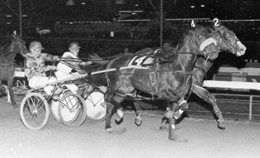
Our Sir Vancelot was pulled up in the 1996 final but he proved superior in 1997, 1998 and 1999 as he became the first horse to win the ultimate prize three times. His trainer/driver Brian Hancock retired from race-driving at the end of the 2002/2003 season as the most successful driver in Inter Dominion history with five driving successes with Koala King (1980), Weona Warrior (1994) and Our Sir Vancelot (1997,1998 & 1999). Hancock also leads the Inter Dominion Trainers List with five wins with Thorate (1990), Weona Warrior (1994) and Our Sir Vancelot (1997,1998 & 1999). The 1996 Inter Dominion Final was won by the Frank Scaravilli owned and Gary Hancock trained Young Mister Charles which was the last horse nominated for the Championship. The faxed nomination arrived just five minutes prior to the nomination deadline after a phonecall from WATA Racing Secretary Alan Parker. Scaravilli explained that the weather in Perth was too hot. Parker pointed out that the 6yo gelding had won South Australia's premier race in 40 degree heat. The rest is history as an overjoyed Scaravilli collected the $250,000 first prize and Parker received a pat on the back for the phonecall. 1996 INTER DOMINION FINAL
STAKE: $400,000 DISTANCE 2,500 metres (Mobile)
Margins: 8 yards, 3 inches, 6 yards
Trainer of winner: M G Stephens
Owner of winner: M G Stephens |
|
Western Australian Inter Dominion Champions
|
Copyright
©2003 Western Australian Trotting Association. All rights reserved. This material may not be published, broadcast, rewritten or redistributed in any form without permission. Design by gtorto@bigpond.net.au |